

AI Voice Transcription in GP Consultations: The Benefits, Risks and What Patients Should Know
AI tools and AI transcription are increasingly being used to help GPs produce consultation notes, summaries, referral letters and other clinical correspondence. Often described as ambient voice technology or AI scribing, the software listens during an appointment and turns the conversation into a draft record for the clinician to review.
Used well, it can reduce administration and let clinicians focus more fully on the patient. Used without proper safeguards, it can also introduce errors into an important medical record. We look at how the technology works, what patients should expect and where responsibility lies if something goes wrong.
Key takeaways
- What it is: Software that captures a clinical conversation and produces a draft transcript, summary or letter.
- Main benefit: Less time typing can mean better eye contact, more focused conversations and less work after the appointment.
- Main risk: The system can mishear, omit or wrongly summarise information, particularly in noisy or multi-speaker consultations.
- Patient choice: Patients should be told when an ambient scribe is being used and can ask for it not to be used.
- Human review: The clinician must check the output before it is added to the record or used for a referral or letter.
- Legal position: Using AI does not remove the clinician’s responsibility for the accuracy of the final record.
What is AI voice transcription?
Ambient voice tools capture speech during a consultation and convert it into text. Some create a near-verbatim transcript; others use generative AI to turn that transcript into a structured clinical note, a patient letter or a draft referral.
The technology is intended to support documentation, not to replace the GP’s clinical judgement. The output should remain a draft until the clinician has checked that it accurately reflects the conversation and any decisions made.
How does it work during a consultation?
The precise process varies between practices and products, but it will usually involve the following steps:
- The clinician tells the patient that an ambient scribe will be used and addresses any questions or objections.
- A microphone or approved app captures the conversation during the appointment.
- The system produces a draft transcript, summary, letter or referral.
- The clinician reviews and edits the output, checking important details such as symptoms, medication, dosages and follow-up actions.
- Only the approved version is added to the medical record or sent onwards.
What happens to the audio depends on the product and the practice’s arrangements. Patients should not assume it is always deleted immediately; the practice should be able to explain how it is processed, how long it is kept and who can access it.
Why are GP practices using it?
Clinical documentation takes time during and after appointments. By drafting notes and correspondence automatically, ambient scribing can reduce repetitive administration and allow the clinician to concentrate on the conversation rather than the keyboard.
- More attention: The GP can maintain eye contact and listen without constantly typing.
- Less administration: Draft notes and letters can be produced quickly for the clinician to check.
- A clearer workflow: Structured drafts can help organise symptoms, decisions and next steps consistently.
“During a recent consultation, I was told that the doctor was using AI transcription to prepare his notes. I was initially concerned about the accuracy of the notes and the referral that would follow, but the doctor reassured me that he would check both and could return to the recording if anything needed clarifying. The end result was fine, and it meant he could focus more fully on my symptoms and our conversation.”
Nimish Patel, Head of Personal Injury at McHale & Co
The technology is also beginning to appear in the correspondence patients receive after appointments.
“My grandmother recently received an AI-generated letter following a medical appointment. There were no issues with it, so our own experience of the technology has been positive.”
Gabriella Lavorini, Paralegal Apprentice at McHale & Co
Where can AI transcription go wrong?
No transcription system is flawless. A tool may mishear a drug name, omit a symptom, confuse who said what or summarise a conversation in a way that changes its meaning. Generative systems can also introduce information that was not actually discussed.
Background noise, overlapping speech, several people in the room and telephone or video quality can all affect performance. Accuracy may also vary between speakers, so practices need to test systems across a realistic range of voices and consultation settings rather than assuming that one headline figure applies to every patient.
Medication and referral details require particular care. A wrongly recorded drug, dosage or follow-up action could affect treatment if it is not caught. This is why any AI-generated note must be checked by the clinician before it becomes part of the official record. McHale & Co also explains the wider issues that can arise from medication errors on its drug side effects claims page.
Patient information, privacy and choice
According to NHS England’s guidance for patients and service users, a healthcare professional using an ambient scribe should tell the patient at the beginning of the session. Patients can ask for the tool not to be used, and that choice should be respected.
The practice remains responsible for using an appropriate product and protecting confidential medical information. It should be able to explain what data is captured, where it is processed, whether the audio is retained and how the final note is checked.
If you are unsure, three useful questions are:
- What will the system record or generate?
- What happens to the audio and other data after the appointment?
- Who will check the note, referral or letter before it is used?
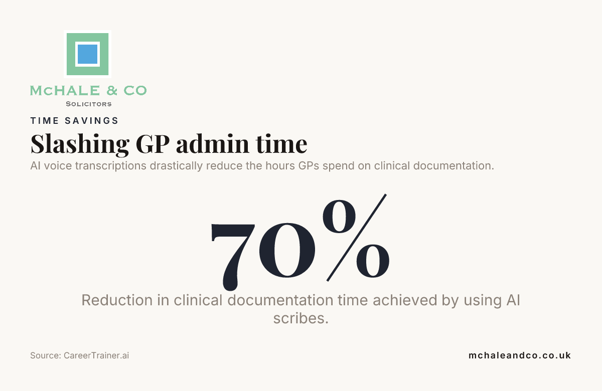
AI voice transcriptions drastically reduce the hours GPs spend on clinical documentation.
What happens if an AI-generated record is wrong?
An inaccurate note does not automatically mean that negligent care has occurred. The important questions are whether the clinician checked the output, whether the final record accurately reflected the consultation and whether any error caused avoidable harm.
If an unchecked error contributes to a missed referral, delayed diagnosis, medication mistake or other injury, the circumstances may need to be investigated. The use of AI does not transfer responsibility away from the healthcare professional or practice that approves and relies on the final record. You can read more about what to do after a medical accident.
A patient who believes the record is wrong should raise it with the practice promptly and request a copy of the relevant notes and correspondence. If the error has affected treatment or caused significant harm, they may also wish to seek specialist advice about a possible general practice claim.
Conclusion
AI voice transcription can be a useful support tool. It may reduce administration and help clinicians give patients more attention, as the experiences above suggest. But the benefit depends on transparent use, appropriate data safeguards and careful human review. The AI-generated output should be treated as a draft, never as the final word.
Frequently asked questions
Are AI voice transcription tools safe to use in GP consultations?
They can be used safely when an appropriate product is in place and the clinician checks every output before it is saved or acted upon. The main risk is an error being accepted without proper review.
Does my GP have to tell me that an ambient scribe is being used?
NHS England says patients should be told at the beginning of the session. You can ask for the tool not to be used during your appointment.
What should I do if my AI-generated note or letter is wrong?
Contact the practice promptly, explain the error and ask for the record to be reviewed. Keep copies of the note, letter and any related correspondence, particularly if the mistake has affected a referral, prescription or treatment.
Can an AI transcription error lead to a clinical negligence claim?
Potentially, but an error alone is not enough. A claim would usually require evidence that the standard of care fell below what was reasonably expected and that this caused avoidable injury. Each case depends on its own facts. For more information, see McHale & Co’s general practice claims page.